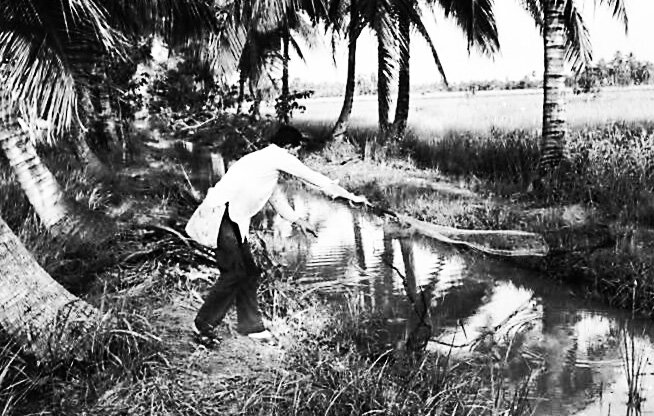
1900–1910: the Krian Irrigation Scheme
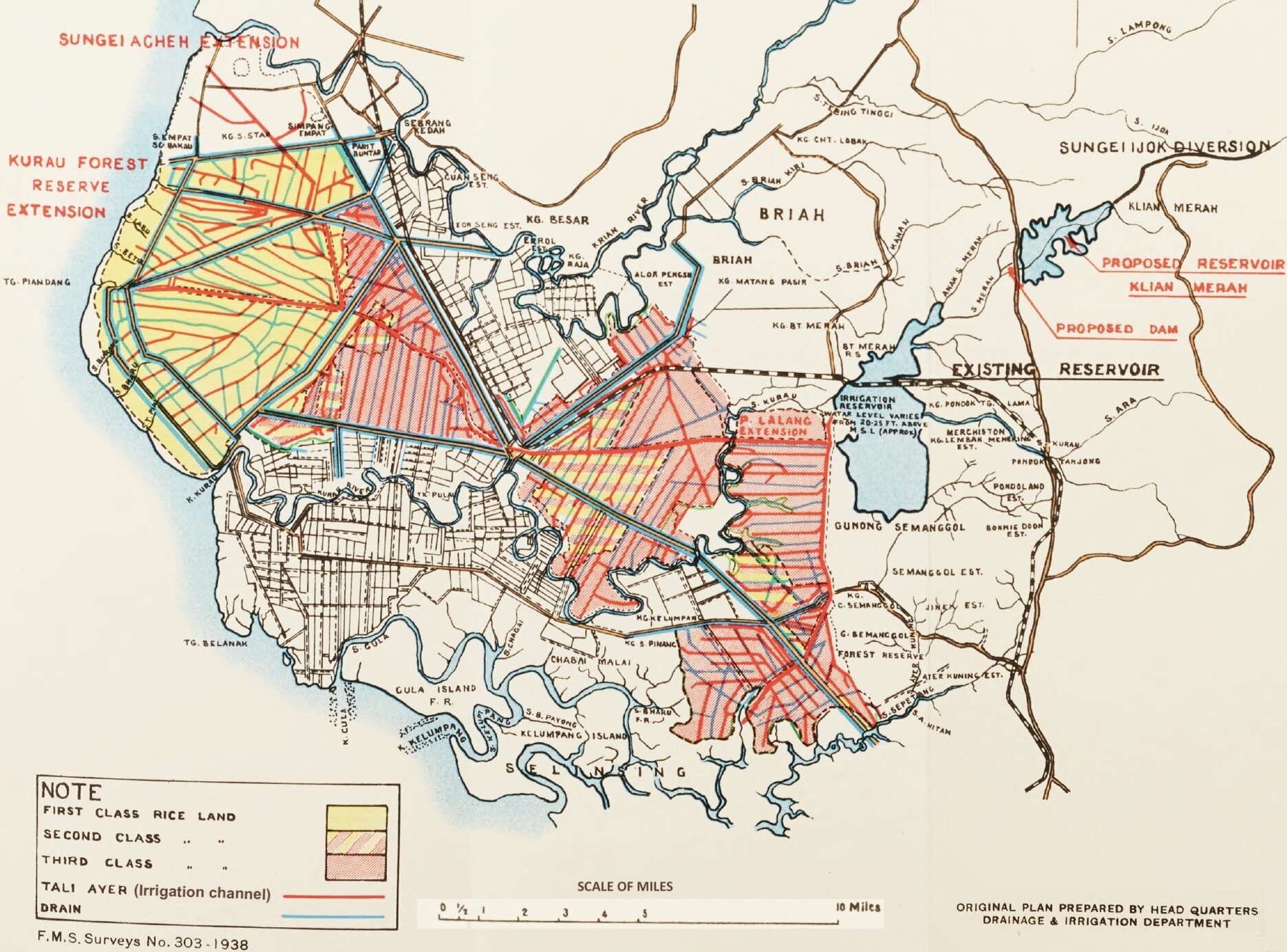
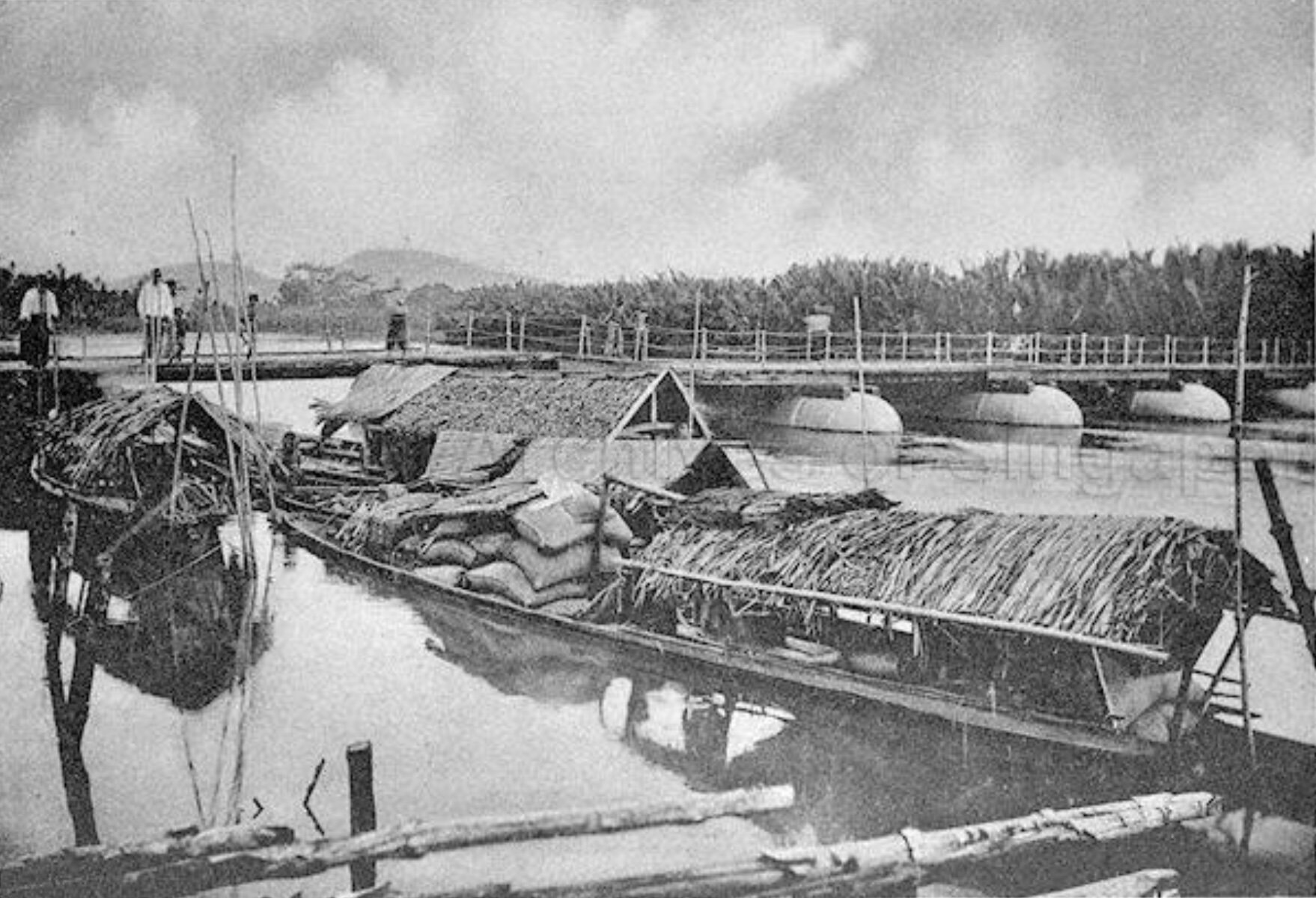
1910–1940: market uncertainty and two economic downturns
Both during the last war and in the 1922 and 1932 slumps pressure was brought to bear on the department to allow the disforestation of allegedly suitable areas in reserves, with results that have been entirely negative. … A firm stand should be made against enthusiastic but inexperienced amateurs who know little about rice cultivation and who do not realize that Malayan soils are not naturally prolific, most of them owing what fertility they possess to the presence of forest.13The warning was prescient. During their Occupation of Malaya, the Japanese administration cleared forest and rubber land to create space for food crops and forced many urban residents with no agricultural experience to move to the country and grow vegetables. The results were notably poor, and when people who had been forced to relocate abandoned their vegetable plots after the war and moved to squatter settlements near urban areas, food shortages were exacerbated.
The Japanese Occupation and food supply shortages
Owing to the clearing out of high areas for planting of Foodcrops during the present emergency, soil erosion has been observed to be responsible for the increasing higher beds of the Langat and Semenyih River. As a result of the silting out of the river beds, the District has experienced very frequent and destructive floods even at slight showers causing severe damage to Foodcrops especially Wet Padi which are planted along valleys of the District.15To encourage cultivation of rice and other food crops, the Japanese government defined farmers as ‘self-supporters’, making them ineligible to draw rations. Over the course of the Occupation, as the amount of food available for distribution on the ration declined, the government increased the number of people designated as self-supporters. Then, in the latter part of the Occupation, the Japanese restricted the amount of rice that farmers could keep for personal use, telling them to grow and eat tapioca and sweet potatoes. In Pahang, where the amount rice farmers could retain was based on a particularly low ration, 0.7 pounds per day for adult males and 0.5 pounds for females, the Japanese Governor acknowledged that the amount was inadequate but told farmers they had to sacrifice for the sake of the urban population. 16

Food supplies during Malaya’s post-war recovery
Reports have been received of extensive damage to anti-malarial and other engineering works, and the silting up of a town’s water supply intake, irrigational channels and padi fields. These are the immediate and direct results of clearing and exposing steep slopes to erosion; the far-reaching consequences, which result from the silting up of the larger rivers, and which only develop at a later date, are the ruination of the lower riparian lands consequent on seasonal flooding and the accompanying danger of epidemics.18In May 1946, the Food and Agriculture Organization of the United Nations established an International Emergency Food Council (IEFC) to regulate international trade in foodstuffs. The IEFC in turn created a sub-committee responsible for allocating rice to territories that needed imports to sustain the resident population. Rice remained under international control until 1949.
Rice cultivation and preparations for independence
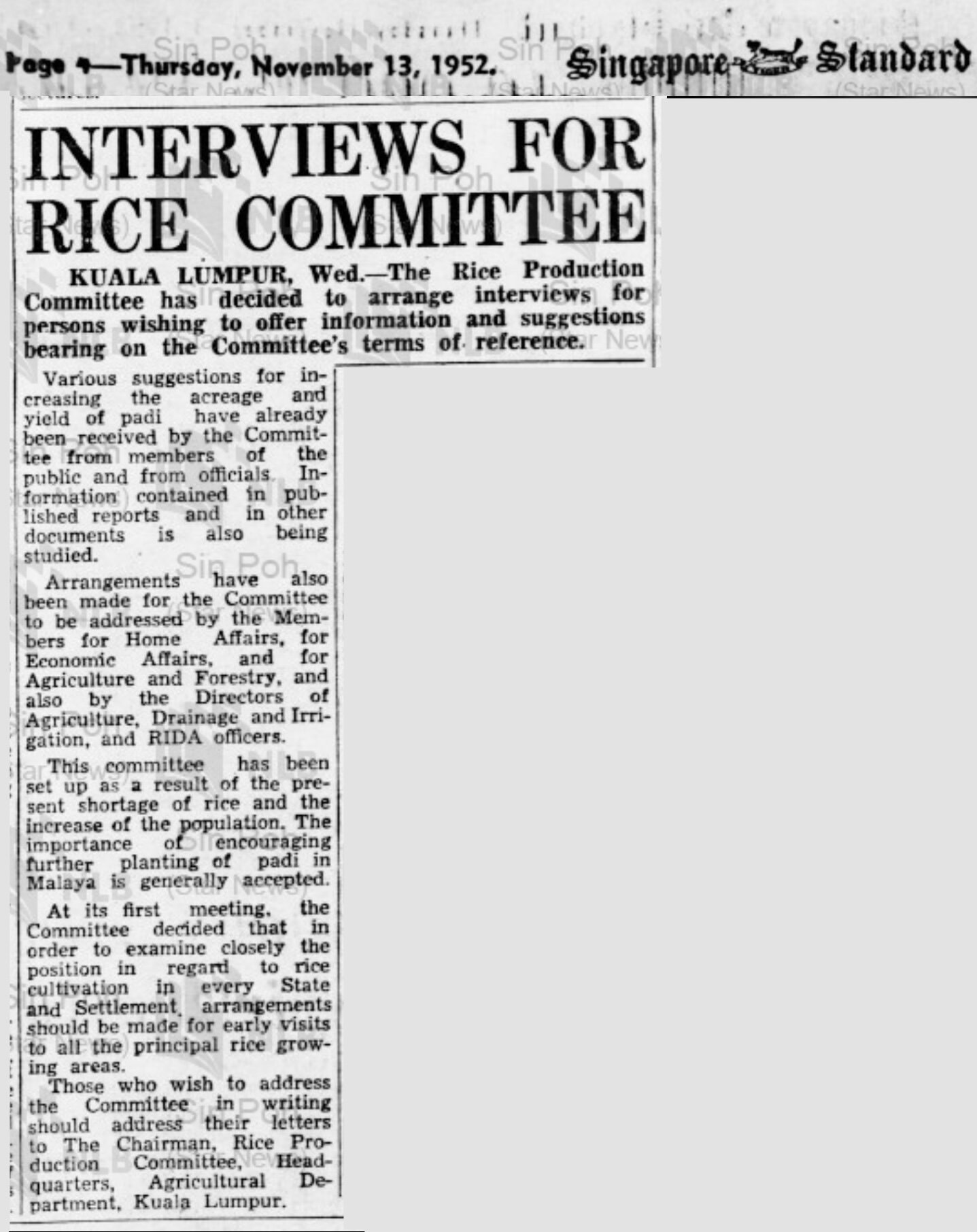
The Committee’s report noted that the quality of life in rural areas was unsatisfactory and made worse by rising prices for consumer goods. Non-agricultural work offered better incomes than farming. Towns and cities provided amenities and employment opportunities that drew people away from rice farming, particularly in places with poor soils. The Committee rejected the idea that simply increasing the price of padi by setting a minimum price would solve the problem, saying that rural communities required better housing, schools, markets, and communications, and that the rice bowl areas of northern Malaya in particular needed better water control.
The report concluded that little could be done to increase production on existing rice land and recommended opening new areas for rice cultivation and setting aside ‘a very substantial sum’ for a padi development fund. The State Agricultural Officer for Selangor, who was a member of the Rice Investigation Committee, observed that rice grew best on ‘the heavier coastal and river alluvium soils’, which in many areas were planted with rubber. He pointed out that yields from rubber trees grown on such land were relatively low and suggested converting some rubber land to rice cultivation. The government of the Federation of Malaya agreed in principle to the acquisition of rubber land but declined to provide any funds for the purpose.
The 1953 report departed from previous studies on rice cultivation in several ways, but the major innovation related to Malay land ownership and Malay farmers. The Malay Reservations Enactment had attempted to ensure that rural Malays held sufficient land to maintain their customary lifestyle, but the policy had become intertwined with initiatives to increase domestic rice production. Restrictions on the crops that could be grown on Reservation land had had no effect on the level of imports but had contributed to rural poverty. In 1951, a newly created Rural and Industrial Development Authority began exploring ways to improve the economic position of the Malay population, and in 1952 the state of Selangor launched an enquiry into why Malays had not entered business life. Insofar as it dealt with rice cultivation, the conclusion was that unfavourable marketing arrangements for rice and other rural produce kept the rural Malay population from accumulating capital to invest in businesses (Federation of Malaya, 1953).22
The consumers have no more grounds for thinking that they have an inalienable right to cheap rice in sufficient quantities at all times (particularly since the majority of the rice they eat is imported) than the producers have for expecting that they should be subsidized into a happy state of affairs where intermittent work over 7–8 months a year will provide them with a decent standard of living.
Conclusion
Bauer, P. T. 1961. ‘Some Aspects of the Malayan Rubber Slump 1929–1933’, in T. H. Silcock (ed.), Readings in Malayan Economics. Singapore: Eastern Universities Press.
Donnison, F. S. V. 1956. British Military Administration in the Far East, 1943–1946. London: Her Majesty’s Stationery Office.
Department of Agriculture, Straits Settlements and Federated Malay States. 1940. ‘The Development of Rice Cultivation in Malaya’. Malayan Agricultural Journal, 28, pp. 472–478.
Federation of Malaya. 1950. Draft Development Plan of the Federation of Malaya. Kuala Lumpur: Government Press.
______ 1953. Report of the Rice Production Committee. Kuala Lumpur: Government Printer.
______ 1956. Final Report of the Rice Committee. Kuala Lumpur: Government Printer.
Hill, R. D. 1977. Rice in Malaya: A Study in Historical Geography. Kuala Lumpur: Oxford University Press (reissued 2012. Singapore: NUS Press).
Jack, H. W. 1927. Rice in Malaya. Bulletin No. 35, Department of Agriculture, Federated Malay States and Straits Settlements. Kuala Lumpur: Methodist Publishing House.
Kratoska, P. H. 1983. ‘“Ends that We Cannot Foresee”: Malay Reservations in British Malaya’. Journal of Southeast Asian Studies, 14(1), pp. 149–168.
______ 1988. ‘The Post–1945 Food Shortage in British Malaya’. Journal of Southeast Asian Studies, 19(1), pp. 27–47.
______ 1990. ‘The British Empire and the Southeast Asian Rice Crisis of 1919–1921’. Modern Asian Studies, 24(1), pp. 115–146.
______ 1998. The Japanese Occupation of Malaya: A Social and Economic History. Honolulu: University of Hawai‘i Press.
Overton, J. 1989. ‘The State and Rice Production in Malaya in the Late Colonial Period’. Unpublished paper for the Malaysia Society of the Asian Studies Association of Australia.
Rosedale, J. L., and Milsum, J. N. 1940. Malay Leaf and Other Vegetables and Their Analysis. Kuala Lumpur: Federated Malay States Government Press.
Short, D. E. and James C. Jackson. 1971. ‘The Origins of an Irrigation Policy in Malaya: A Review of Developments Prior to the Establishment of the Drainage and Irrigation Department’. Journal of the Malaysian Branch of the Royal Asiatic Society, Vol. 44, No. 1, pp. 78–103.
South, F. W. 1949. ‘Report on Padi Areas and Padi Production in Malaya during the Season 1945–1946’. Malayan Agricultural Statistics, 1949, Table 30.
Wilkinson, R. J. 1957. ‘The Incidents of Malay Life’, in Papers on Malay Customs and Beliefs. Journal of the Malayan Branch of the Royal Asiatic Society, 30(4) (180), pp. 41–79.
Willis, J. C. 1905. A Report upon Agriculture in the Federated Malay States, 1904. Kuala Lumpur: Government Printing Press.