Articles
The Malaysia Agreement 1963
Professor Andrew Harding, Academic Fellow, Centre for Asian Legal Studies, National University of Singapore1

In 2022, the Malaysian Parliament passed the Constitution (Amendment) Act 2022,2  amending the Federal Constitution in two important respects.

First, the 2022 amended text implicitly restored the particular status of Sabah and Sarawak within the Federation. As was the case prior to a constitutional amendment in 1976, Sabah and Sarawak are now listed separately from Malaysia’s other 11 states.3  The 1976 amendment was motivated by a perceived need to create equality between the states. Yet the implication of the 2022 amendment is the opposite—that the states are not precisely equal and that the special status of Sabah and Sarawak is mandated and defined by the Malaysia Agreement 1963 (MA63).

Second, the 2022 amended text recognises the significance of MA63 as a national foundational document that defines the Federation.4  The Federation is now defined in Article 160(2) of the Federal Constitution as: 
‘the Federation that was first established under the Federation of Malaya Agreement 1957 and further pursuant to … [MA63 and] called Malaysia’
with Sabah and Sarawak federated with the existing States of the Federation of Malaya ‘in accordance with the constitutional instruments annexed’ to MA63.

The changes effected by this amendment5  could be considered symbolic, having no practical consequences. Some have even advanced the view that the constitutional position of equality between Malaysia’s 13 states remains unaltered (The New Straits Times, 2026a).6  Yet, since 2022, the debate about the status of natural resource-rich Sabah and Sarawak has moved to issues of enormous practical relevance, such as Sabah’s constitutional grant entitlement (The New Straits Times, 2026b),7  and the right to exploit Sarawak’s territorial sea.8  This article first outlines the historical context in which MA63 originated, and how it survived international and internal challenges. It then makes an assessment of the agreement and puts forward the case for greater autonomy of Sabah and Sarawak. 

The making of the Agreement

The historical circumstances of the making of MA63 are highly relevant to its status and the fundamental nature of Malaysian federalism.

In the early 1960s, following the attainment of independence by the Federation of Malaya in 1957, the question arose as to the fate of the other British territories in Southeast Asia (namely Singapore, Brunei, Sarawak, and North Borneo). A Commission of Enquiry, North Borneo and Sarawak, known as the Cobbold Commission, was established jointly by the British and Malayan governments in early 1962. The Commission’s report was published on 1 August 1962, recommending the establishment of a new Malaysian federation, and finding there was general support in these two states for federating with Malaya (Colonial Office, 1962a). 

The British and Malayan governments then decided to establish an Intergovernmental Committee (IGC), comprising these two governments plus those of North Borneo (called Sabah after MA63) and Sarawak, to consider arrangements for the establishment of the new federation. The IGC reported in 1962 (Colonial Office, 1962b). Clause 11 of its report made it clear that the new constitutional arrangements would ‘include safeguards for the special interests’ of Sabah and Sarawak. Clauses 15–32 set out agreements on a wide range of matters ranging from religion and finance to constitutional safeguards.

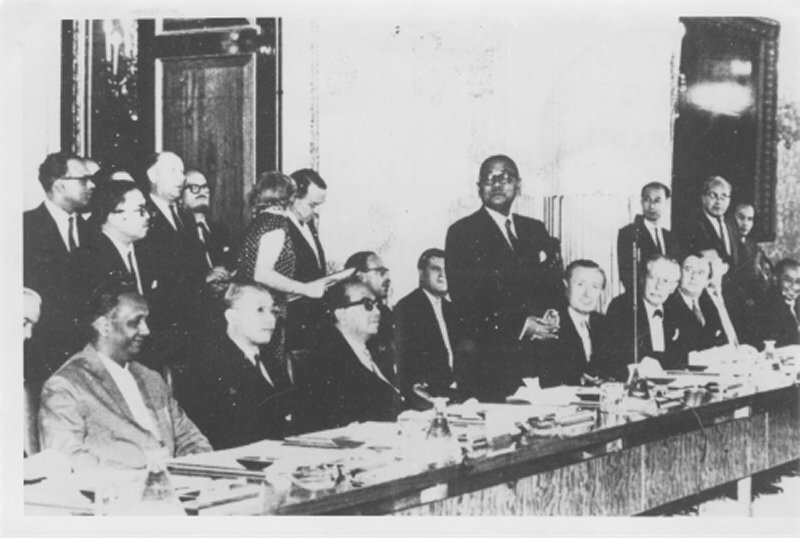
MA63, as envisaged by the IGC, was signed in London on 9 July 1963. Following the passing of the Malaysia Act 1963 (UK) by the Westminster Parliament on 31 July 1963, the Malaysia Act 1963 (Federation of Malaya) was passed by the Malayan Parliament on 20 August 1963.9  This latter Act provided for amendments to the Federal Constitution that had been set out in Annex A to MA63. A United Nations Mission (16 August to 5 September 1963) to North Borneo and Sarawak concluded that there was democratic support for the federation (Tan, 2008, pp. 189–190). Accordingly, MA63 came into effect on 16 September 1963 (Tan, 2014). 10

Prime minister Tunku Abdul Rahman Putra speaking at the signing ceremony for the Malaysia Agreement in London, July 1963.
Source:
National Archives of Malaysia: Accession No. 2001/0049902W.

Indonesia strongly opposed the new federation, and its inauguration led to a period of great tension and confrontation (konfrontasi) between Malaysia and Indonesia that involved military incursions, and also an emergency proclamation in Malaysia (Mackie, 1974; Tan, 2007). The facing down of Indonesia in 1964–1966 has been called ‘Malaysia’s finest hour’ (Tan, 2007). The toppling of President Sukarno in 1966 brought a definitive end to konfrontasi. The Malaysian Federation was now firmly established.

Challenging the Agreement: The Kelantan case

A notable fact about MA63 is that it was signed by the five governments, namely those of the United Kingdom, the Federation of Malaya, Sarawak, North Borneo, and Singapore, but not by the 11 states of the existing Federation. In furthering the IGC Report and MA63, the Federation acted as if it were a unitary state, including no representation of the states and failing to even consult the state governments, let alone obtain their consent. The states would surely have needed persuasion to agree to a constitutional position that accorded greater powers to the three new states than they themselves enjoyed (Harding, 2022).11  The Government of Kelantan maintained that MA63 amounted to a breach of the existing federation bargain under the Federation of Malaya Agreement 1957, which formed the basis for independence under a federal system of government, initially created by the Federation of Malaya Agreement 1948 (Harding, 2022).

A few days before Malaysia Day on 16 September 1963, the Government of Kelantan commenced legal proceedings against the Federal Government and Prime Minister Tunku Abdul Rahman for declarations that both MA63 and the Malaysia Act 1963 (and therefore the constitutional amendments) were null and void, or alternatively, were not binding on Kelantan (Jayakumar, 1964). Kelantan’s case was in essence that the Malaysia Act would abolish the Federation of Malaya, thereby violating the 1957 Agreement. By constitutional convention, Kelantan argued, the consent of each of the constituent states, including Kelantan, was required for these changes to be effective. Kelantan asked the court for a temporary injunction that would block the inauguration of Malaysia until the matter could be fully argued on the merits in court.

James Beveridge Thomson, Chief Justice of the Federation of Malaya, who later became the first Lord President of the Federal Court, hearing the application, decided to deal with the case as if it were a full hearing. This was a breach of normal process, but he considered it justifiable in view of the urgency and high importance of the subject matter. In dismissing Kelantan’s case, he held that he could
‘not see that Parliament went in any way beyond its powers or that it did anything so fundamentally revolutionary as to require fulfilment of a condition which the Constitution itself does not prescribe’ (Jayakumar, 1964).
This concluding statement sits uneasily with his premise, which was that the power of Parliament to amend the Constitution is limited only by the terms of Article 159: that is, it requires a two-thirds majority in both Houses of Parliament and the consent of the Conference of Rulers.

This judgement has also been superseded by subsequent authority indicating that a constitutional amendment cannot violate the Constitution’s basic structure, which clearly includes the federal nature of the governmental structure (Tan and Lee, 2025, p. 11).12  Authority from Canada also offers clear support for the position that consultation with the subjects of a federation is a conventional requirement where the nature of the federation is being changed.13  If this were not the case, then a federal government could lawfully, unilaterally, and without recourse make fundamental changes to the original federal bargain to the disadvantage of any of the states (for example, by taking over state powers or resources, or even abolishing a state).

Adopting a new federal structure in which some states have more advantages than others, despite Thomson’s judgement, appears indeed to be ‘fundamentally revolutionary’. This decision is incorrect, and in light of current authority, cannot be regarded as sound law laying down the extent of federal powers over the states. If this reasoning is correct, we can ignore the Kelantan case and conclude that the terms of both MA63 and the IGC Report, as part of the federal bargain concerning Sabah and Sarawak, can be regarded as part of the Constitution’s basic structure, and are therefore legally enforceable (Neo, 2021). 

Overview of the Agreement

MA63 is in essence a very short and in some ways ambiguous document consisting of only 11 Articles (United Nations, 1970; Tan, 2008).

On the Federation, Article 1 states: ‘The Colonies of North Borneo and Sarawak and the State of Singapore shall be federated with the existing States of the Federation of Malaya as the States of Sabah, Sarawak and Singapore in accordance with the constitutional instruments annexed to this Agreement and the Federation shall thereafter be called “Malaysia”’.

The remaining provisions simply set out the legislative and constitutional steps that were to be taken to bring the Malaysian federation into effect. Otherwise, the provisions are purely transitional in nature, covering such matters as defence and public servants. The overwhelming bulk of MA63 lies in 11 Annexes, which also provide in detail for the implementation of the IGC Report principally via the Malaysia Act 1963, the state constitutions of Sabah and Sarawak, and the Immigration Act 1963. 14

While MA63 does an admirable technical job in implementing legally what had been agreed, it is nonetheless disappointing in a number of respects.

It is unclear from the text whether the federation it establishes is a new federation or merely the admission of new states to an existing federation. This critical issue is pursued in the next section below, but it represents ‘a profound ambiguity that has caused serious misunderstanding for the last 60 years’ (Harding, 2025, p. 185). It fails to set out the main principles governing the federation. And it fails to offer any assurance, or even evidence, that the people of Sabah and Sarawak agreed to the changes being implemented (Harding and Chin, 2014; Simandjuntak, 1969). Despite the emphasis in the IGC Report on safeguarding the interests of these two states, it offers no express assurances regarding such safeguards, nor as to their status or rights moving forward, other than are implicit in the constitutional amendments.

Crucially, MA63 does not refer to the ‘18 Points’ (for Sarawak), or ‘20 Points’ (for Sabah), previously raised with the Cobbold Commission and agreed by the Malayan government with the two states respectively, regarding their social, economic, and political needs and circumstances. Some of these Points are referred to in the IGC Report (for example, regarding religion [Article 15] and finance [Article 24]). But there is no attempt to lay them out comprehensively. They were considered by the IGC in terms of possible inclusion in a ‘new Malaysian Constitution’, which did not materialise. Some of the Points were inserted into the new provisions of the Constitution (Chin, 2013). One can only speculate why, given the establishment of a new federal structure, a new constitution was not adopted. It could be that such a process would conceivably lead to other constitutional demands and consequent protraction of the process of federation.
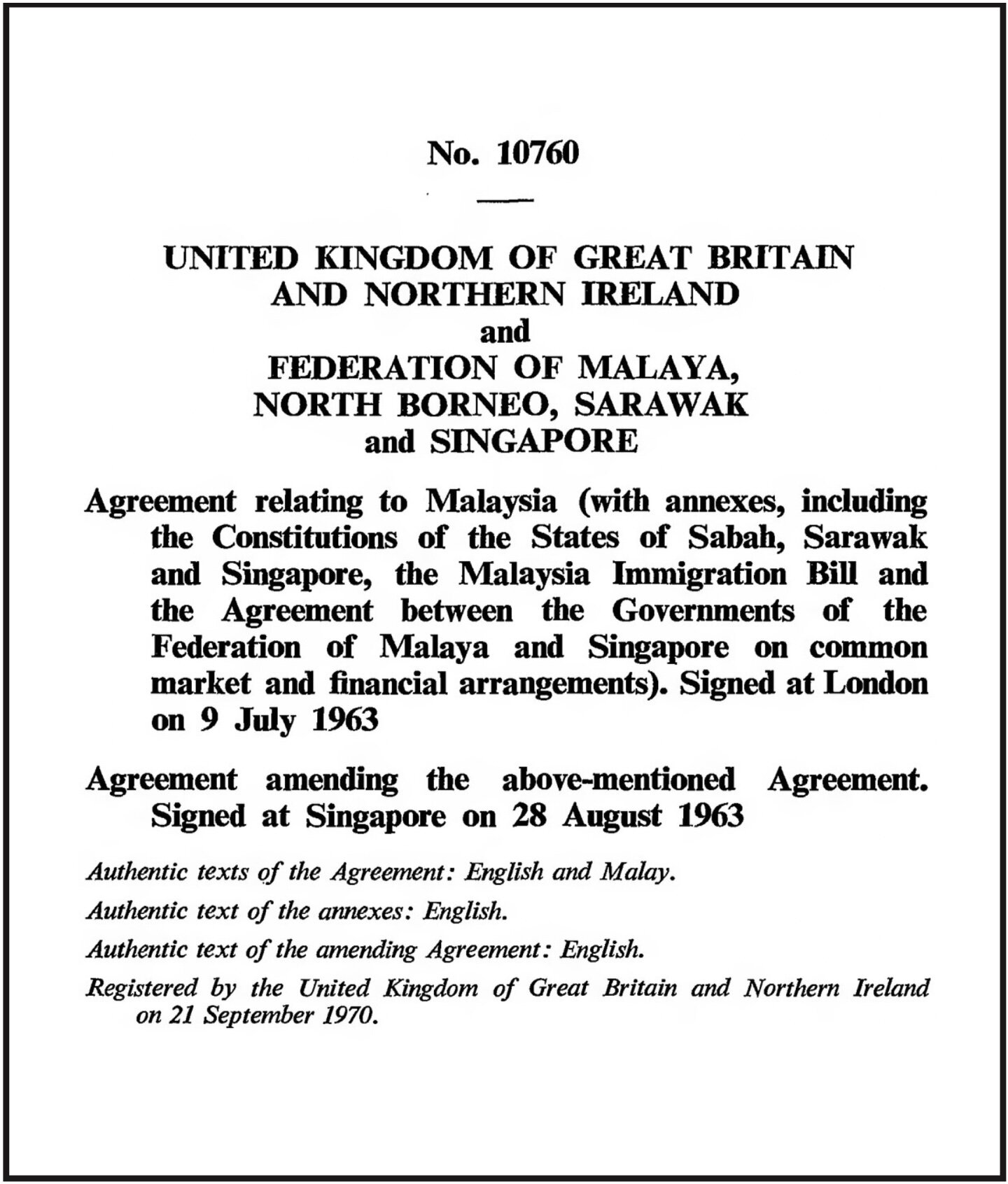
  Front page of the Malaysia Agreement 1963.

The Agreement as a constitutional document

MA63 was signed by five parties as indicated above. It is an international treaty, listed with the United Nations, and is thus an instrument enforceable in international law. It provides for a form of asymmetrical federalism in the form of special regional autonomy that is unusual in constitutional law. An important difference from other cases, such as Bangsamoro, an autonomous region in Muslim Mindanao, the Philippines, is that autonomy was not granted by a unitary state by way of concession following insurgency, but was a condition for the creation of the Malaysian federation (Harding and Chin, 2014).

The amended Federal Constitution implemented MA63 in many of its provisions. Distribution of legislative and executive powers is dealt with in Articles 95A and 95B, for example. Financial provisions, including those for special grants,15  are provided in Articles 112A–D, while reservation of quotas for natives of Sabah and Sarawak is provided in Article 153. The added Part XIIA of the Federal Constitution is of the greatest importance, as it provides for official language matters, the special position of natives of Sabah and Sarawak, and rights to practice before the courts in the two states. But Article 161E exceeds all of these provisions in importance as it provides for a constitutional veto designed to protect the two states from adverse constitutional amendments.

Under Article 161E(2), no constitutional amendment may be made without the concurrence of the Yang di-Pertua Negeri (Governor) of Sabah and/or Sarawak as the case may be (acting on the advice of the state government16) ‘if the amendment is such as to affect the operation of the Constitution as regards’ a number of specified matters. These matters include citizenship and equal treatment of citizens, judicial arrangements, legislative and executive powers, cultural issues affecting religion, language, and the protection of indigenous peoples, and parliamentary representation (Harding and Chin, 2014).17  Judicial decisions have supported the justiciability and binding nature of MA63 and the IGC Report.18  MA63 is now part of the very definition of the Federation, and the prospect is opened of further litigation designed to enforce particular aspects of these documents (The Edge Malaysia, 2026).

In spite of the position as it appears from the Constitution, it is an often-recorded feature of the actual practice of federalism in Malaysia that the federal government has on occasion influenced government tenure at the state level (Chin, 2013). The veto is therefore a requirement that can be seen as largely illusory.

Does the Malaysian Federation comprise thirteen or three subjects?

This question is fundamental to resolving the issues currently being discussed in both political and legal fora. Two contrasting answers can be given based on MA63.

The first is that the terms of MA63, the IGC Report, and the Federal Constitution indicate that a new federation with a new name was established on 16 September 1963, and that, since MA63 was concluded between the existing Federation of Malaya, Sabah, and Sarawak, the federation (or, to look at it another way, that layer of asymmetric federalism) comprises three members.

The second is that on a correct construction of those documents, new states were simply admitted to the existing federation, which changed its name in the process. Advocates of the first view stress the asymmetric aspects, while advocates of the second view stress the equality of states in federal systems.

These arguments are finely balanced and there is much to be said for each point of view (Samad, 2023).19

Adherents of asymmetry can point to the extra powers and privileges given to Sabah and Sarawak that are not accorded to other states. These include not just legislative and executive powers, such as those over immigration and the special grants, but the constitutional veto. They can also adduce the fact that the existing states did not sign MA63, nor were they consulted. Article 2(a) allows Parliament to admit new states to the Federation, but this provision is nowhere referred to in the IGC Report, MA63, or the Malaysia Act 1963. The phrase used in all the documentation is ‘federation of North Borneo, Sarawak and Singapore with the existing States of the Federation of Malaya’, not ‘the admission of new states to the federation’.

Adherents of equality can point to the fact that the documentation does not unambiguously state that a ‘new federation’ was being established, that the court upheld the process whereby Malaysia was established, and that the wording used indicates a federation with the existing 11 states. Furthermore, the idea of a federation of three subjects is undermined by the fact that the Federation of Malaya as an entity with a government and a legislature ceased to exist, and that federal powers embrace all 13 states (Harding and Chin, 2014).

The case for greater autonomy

During the first quarter of the 21st century, and especially since the Barisan Nasional lost political power in 2018, a greater sense of nationalism has emerged in Sabah and Sarawak. All political parties in these states embrace a claim for at least a degree of greater autonomy, while some even advocate secession.20  Such claims do not logically have to rely on MA63, but it does feature very strongly in the way the claims are articulated. They rely on the notion that MA63, the IGC Report, and the ‘18 and 20 Points’ have not been honoured in practice since 1963, to the disadvantage of the two states.

The issues raised by advocates of autonomy, as summarised by James Chin (2013), are:
  1. There is an economic imbalance between East and West Malaysia, in which Sabah and Sarawak, having the majority of Malaysian natural resources, nonetheless experience a development deficit (Harding and Chin, 2014).
  2. There has been political interference (often behind the scenes) with the appointment or tenure of state governments (Chin, 2013).
  3. Federal overreach has embraced the exploitation of natural resources in the form of a state royalty of only 5 per cent, and the taking over of territorial sea resources by the Federation (Chin, 2013).
  4. The enthusiastic granting of citizenship to recent migrants, especially in Sabah, has altered the demographic balance in that state (Chin, 2013).
  5. Cultural and religious overreach is evident in terms of religious conversions, Malay as the national language, and the lack of protection of the indigenous peoples (Harding and Chin, 2014).
These issues are considered to be protected by the documentation of 1963 or else fall within the spirit thereof. There is a spectrum of opinion, however, regarding the relevance of MA63 to these issues.

One faction advocates secession21  on the basis that MA63 has been serially breached by the federation (Chin, 2013). Another advocates the striking off of MA63 on the ground that it was never validly adopted in the first place, the people of the two states not having properly given their consent and thereby being victims of a denial of self-determination (The Star, 2023).

The parties in government in Sabah and Sarawak appear to proceed on the basis that the issue of fulfilment of MA63 needs to be negotiated with the federal government, and in this respect their parliamentary support represents a strong bargaining position. This can be seen as a form of ‘cooperative federalism’ (French, 2018). It appears that a great deal can be done to enhance autonomy by implementing MA63 without resort to constitutional amendment or legislation. For example, one issue debated in Sarawak concerns the use of English as the medium of instruction in the education system. Changing this medium from Malay to English would require only an order of the minister under the Education Act. 22

The 2022 constitutional amendment process was seen to work to good effect for Sabah and Sarawak seeking greater autonomy, although such amendment requires political consensus. Possible areas of change could include the devolution of further powers to Sabah and Sarawak, and greater representation in either House of Parliament (The New Straits Times, 2026c). Such projects can embrace, but do not have to be confined to, the honouring of MA63.

Conclusion

Greater attention to political and legal process in 1962–1963 could have avoided many of the issues to which MA63 continues to give rise. Deep ambiguities were created and it is surprising that it has taken so long for these to surface and be resolved.

The outcome of current debates remains unclear. Will they lead to a balance of powers based more accurately on MA63? Or will they lead to a new Malaysia Agreement incorporating a greater degree of devolution than MA63 provides for, involving, for example, more powers over health, education, and policing? MA63 seems destined to be the source of continued disagreement. The clutches of history are always difficult to escape.

Further reading

Bociaga, R. 2020. ‘BorneoExit: Independence for East Malaysia?’. The Diplomat, 11 December.

Chin, J. 2013. ‘A Brief History of The Malay Peninsula and Northern Borneo’ and ‘The Formation Of Malaysia’, in P. Mathews (ed.), 1963–2013 Chronicle of Malaysia: Fifty Years of Headline News. Kuala Lumpur: Editions Didier Millet, pp. 15–16 and 21–31.

Colonial Office. 1962a. Report of the Commission of Enquiry, North Borneo and Sarawak, 1962. Cmnd 1794. London: Her Majesty’s Stationery Office.

________ 1962b. Malaysia: Report of the Inter-Governmental Committee, 1962. Kuala Lumpur: Government Printer.

French, R. 2018. ‘Cooperative federalism’, in Saunders, C. and Stone, A. (eds), The Oxford Handbook of the Australian Constitution. Oxford: Oxford University Press.

Harding, A. J. 2017. ‘Devolution of Powers in Sarawak: A dynamic Process of Redesigning Territorial Governance in a Federal System’. Asian Journal of Comparative Law, 12(2), pp. 257–279.

________ 2022. The Constitution of Malaysia: A Contextual Analysis. 2nd ed. Oxford: Hart Publishing, ch. 6.

________ 2025. Territorial Governance in Southeast Asia. Oxford: Hart Publishing, chs 4 and 11.

Harding, A. J. and Chin, J. (eds). 2014. 50 Years of Malaysia: Federalism Revisited. Singapore: Marshall Cavendish.

Jayakumar, S. 1964. ‘Admission of New States: The Government of the State of Kelantan v The Government of the Federation of Malaya and Tunku Abdul Rahman Putra Al-Haj’. Malaya Law Review, 6(1), pp. 181–188.

Mackie, J. A. C. 1974. Konfrontasi: The Indonesia-Malaysia Dispute 1963–1966. Kuala Lumpur: Oxford University Press.

Neo, J. L. 2021. ‘Restoring Constitutional Equality to Sabah and Sarawak: Do the Proposed Amendments to the Malaysian Federal Constitution Go Far Enough?’. ConstitutionNet, 19 November 2021. , accessed 7 September 2026.

Samad, J. 2023. Unequal Partners: Race, Religion, Domination and Inequality in East Malaysia. Petaling Jaya: SIRD.

Simandjuntak, B. 1969. Malaysian Federalism 1945–1963. Kuala Lumpur: Oxford University Press.

Tan, K. Y. L. 2014. ‘Federating for Survival: The Case of Singapore’, in Harding, A. J. and Chin, J. (eds), 50 Years of Malaysia: Federalism Revisited. Singapore: Marshall Cavendish, pp. 112–151.

Tan, K. Y. L. and Lee, H. P. (eds). 2025. The Basic Structure Doctrine in Malaysia: Themes and Perspectives. Oxford: Hart Publishing.

Tan, P.-L. 2007. ‘From Malaya to Malaysia’, in Harding, A. J. and Lee, H. P. (eds), Constitutional Landmarks in Malaysia: The First 50 Years, 1957–2007. Singapore: LexisNexis.

Tan, T. Y. 2008. Creating “Greater Malaysia”: Decolonisation and the Politics of Merger. Singapore: ISEAS.

The Edge Malaysia. 2026. ‘PETRONAS, Petros Feud to be Resolved Soon, Say Sources’, 20 July. , accessed 7 September 2026.

The New Straits Times. 2026a. ‘“Sabah, Sarawak equal to other states in Malaysia”, says law lecturer’, 8 March. , accessed 7 September 2026.

________ 2026b. ‘Federal Govt Granted Stay on Sabah 40pct Revenue Review Pending Appeal’, 6 April. , accessed 7 September 2026.

________ 2026c. ‘35pct Parliamentary Seat Proposal for Sabah, Sarawak Still under MA63 Talks’, 7 August. , accessed 7 September 2026.

The Star. 2023. ‘Kuching High Court Strikes Out Suit to Declare MA63 Null and Void’, 25 May. , accessed 7 September 2026.

United Nations. 1970. Agreement Relating to Malaysia Between the United Kingdom of Great Britain and Northern Ireland, the Federation of Malaya, North Borneo, Sarawak and Singapore, Signed at London on 9 July 1963. United Nations Treaty Series, vol. 750, No. 10760, pp. 2–481.


Endnotes
1 The author is also Professor of Law, University of Reading Malaysia, and Visiting Professor, University of Oxford.
2 Act A1642.
3 Article 1, as amended.
4 Article 160(2)(b), as amended.
5 The status of MA63 had already been recognised by the courts. In Pihak Berkuasa Negeri Sabah v Sugumar Balakrishnan [2002] 3 Malayan Law Journal 72, Mohamed Dzaiddin, Federal Court Judge, regarded the ‘spirit and intention’ of the IGC Report and MA63 as relevant to an issue arising under the Immigration Act; and in Datuk Haji Mohammad Tufail bin Mahmud and 5 Others v Dato’ Ting Check Sii [2009] 4 Current Law Journal 449, which concerned the exclusive right of Sarawak lawyers to practice in Sarawak, the Federal Court treated the same documents as binding. However, the amendment puts the matter of justiciability beyond forensic argument.
6 ‘“Sabah, Sarawak equal to other states in Malaysia”, says law lecturer’, The New Straits Times, 8 March 2026, , accessed 7 September 2026.
7 Sabah Law Society v Government of the Federation of Malaysia and Anor [2026] 1 MLRH 232; ‘Federal govt granted stay on Sabah 40 per cent revenue review pending appeal’, New Straits Times, 6 April 2026, , accessed 7 September 2026.
8 Registered Trustees of Sabah Action Body Advocating Rights (SABAR) v Government of the Federation of Malaysia, OS BKI-24NCvC-157-9/2023 (HC1), High Court, Kuching.
9 Act 26/1963.
10 In the event, Brunei decided not to join the new federation. Singapore joined under the terms of MA63, but left the Federation on 9 August 1965 (Tan, 2014).
11 They were accorded greater powers, more sources of revenue, and a right to veto constitutional amendments affecting them (Harding, 2022).
12 Kesavananda Bharati v State of Kerala [1973] 4 Supreme Court Cases 146 [316], per Chief Justice Sikri (Supreme Court of India). The ‘basic structure doctrine’ has been accepted in Malaysia (Tan and Lee, 2025).
13 Cf. Reference re Secession of Quebec [1998] 2 Supreme Court Reports 217, Supreme Court of Canada.
14 See Annexes A, B, C, and E of MA63.
15 See endnote 8 above.
16 This requirement is (one might add, oddly) for consent of the executive branch rather than the legislative assembly.
17 In Robert Linggi v Government of Malaysia, it was held that Article 122AB of the Federal Constitution (introduced by the Constitution (Amendment) Act 1994, and providing for the appointment of Judicial Commissioners in Sabah and Sarawak) was unconstitutional due to lack of consent by the respective Yang di-Pertua Negeri. It was held that such consent was required as the amendment affected the constitution and jurisdiction of the High Court of Sabah and Sarawak, a matter protected under Article 161E(2)(b).
18 See endnote 6 above.
19 For a trenchant statement of the common position taken in Sabah and Sarawak, see Samad (2023).
20 Bociaga, R. ‘BorneoExit: Independence for East Malaysia?’, The Diplomat, 11 December 2020. This was even recognised by Muhyiddin Yassin, then Malaysia’s Prime Minister, when he stated (ibid.) that, ‘Some people have long desired secession, and in recent years the drumbeat of separation has only grown louder’.
21 MA63 makes no provision, nor does the constitution, for secession. Nonetheless, Singapore seceded, albeit by agreement, on 9 August 1965 (Tan, 2014).
22 Education Act 1996.

SHARE THIS PAGE
RELATED SITES

ECONOMIC HISTORY OF MALAYSIA
c/o Asia-Europe Institute
University of Malaya,
50603 Kuala Lumpur
Ooops!
Generic Popup2