Articles
The Malaysia Agreement 1963: Grievances and Expectations in Sabah and Sarawak
Dr Johan Arriffin Samad, Senior Research Fellow, Borneo History Research Centre, Sabah

‘Equal Partners’ is a term widely used in Sabah and Sarawak to describe the constitutional and political status of the region within Malaysia. The concept of ‘Equal Partners’ embodies the conviction that Sabah, Sarawak, the Federation of Malaya, and Singapore came together in 1963 under the Malaysia Agreement 1963 (MA63)—a United Nations-registered international treaty—as founding partners in the creation of the Federation of Malaysia. In 1965, Singapore seceded and became a separate and fully independent nation.

At a parliamentary sitting in 1976, Sabah and Sarawak’s constitutional position as signatories of MA63 was downgraded through amendments to Article 1(2) of the Federal Constitution, whereby both were merged as two of the 13 constituent states of the Federation of Malaysia, rather than being recognised as distinct entities with a special status under MA63. This was a significant erosion of their special status and constitutional safeguards. The contrasting term ‘Unequal Partners’ has since gained prominence in political and public discourse to express dissatisfaction over federal-state relations, including issues relating to fiscal autonomy, resource sharing, and infrastructure development (Samad, 2023; 2026).

This article briefly reviews the background to the entry of Sabah and Sarawak into the Federation of Malaysia, the grievances that have emerged over the implementation of MA63, and recent efforts to restore its original intent.

Historical background
North Borneo (Sabah) and Sarawak followed distinct colonial paths before becoming part of Malaysia. North Borneo was administered by the British North Borneo Chartered Company from 1881 to 1946, which governed the territory primarily as a commercial enterprise focused on the extraction of timber, rubber, copra, and other natural resources (Massey, 2006). As a result, relatively little investment was made in education and infrastructure, and indigenous participation in governance was limited (Ranjit Singh, 2000).

By contrast, Sarawak was ruled by the Brooke dynasty from 1841 to 1946, which developed a system of administration that combined British colonial institutions with indigenous leadership and customary practices. This system fostered greater local participation in governance and provided Sarawak with a stronger tradition of self-administration.

Following the end of World War II, both Sabah and Sarawak were ceded to the British and became Crown Colonies (Allen, 1968). While Sarawak entered the post-war period with much of its administrative structure still intact, Sabah faced a far more daunting situation. The territory had been devastated by the war, with widespread destruction of its towns, infrastructure, and economy. Contemporary British accounts described North Borneo as being in an appalling condition, observing that ‘no part of the Commonwealth, not even Burma, had been more utterly devastated’ (Tregonning, 1965).

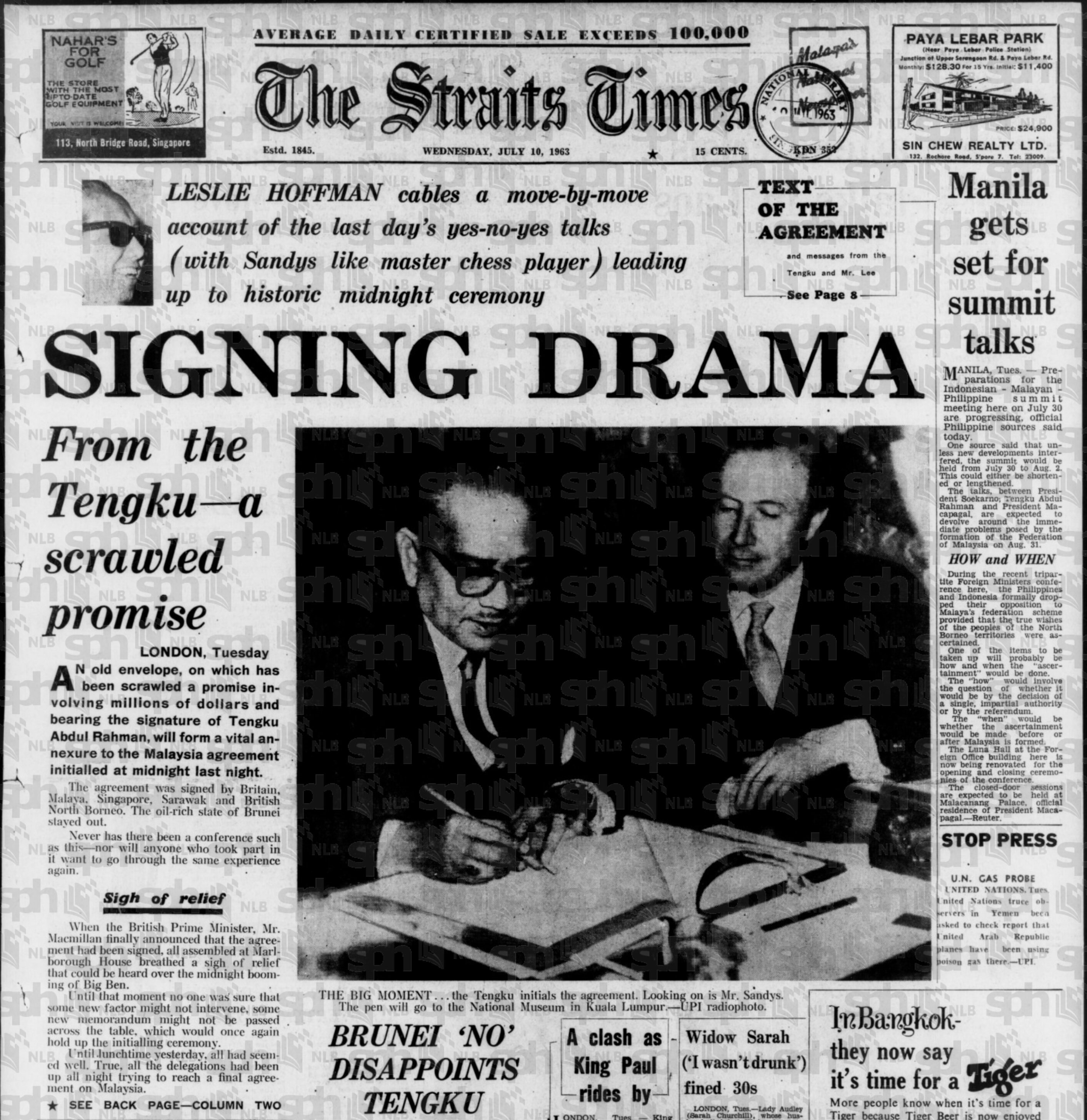
The signing of MA63 in London.
Source:
The Straits Times, 10 July 1963.

Unlike the Federation of Malaya, whose independence was founded on the recommendations of the Reid Commission and a constitution negotiated with the participation of local political leaders and the Malay rulers, the constitutional path of Sabah and Sarawak was markedly different. Although Sabah and Sarawak had their own legislative councils consisting of appointed and elected officials, their future was negotiated primarily between the British and Malayan governments, with limited direct involvement of local leaders.

The idea of merger of the Borneo territories and Singapore with the Federation of Malaya had been part of a ‘Grand Design’ for closer political and economic cooperation that had been discussed earlier by the British government and Tunku Abdul Rahman, the first Prime Minister of Malaya. Without any direct involvement in the decolonisation process, many indigenous leaders opposed the proposed federation, viewing it as a transfer from one colonial authority to another.

The first significant participation by Borneo leaders came through the Malaysian Solidarity Consultative Committee (MSCC), established in August 1961 under the chairmanship of Tun Fuad Stephens, who later became the first Chief Minister of Sabah, 1963–1964 (Colonial Office, 1962b). The MSCC served as a forum to discuss the proposed federation and address the concerns of Sabah and Sarawak. The MSCC’s final report, the ‘Memorandum on Malaysia’, was submitted to the Cobbold Commission on 23 February 1962 and became an important reference in the deliberations leading to the formation of the Federation of Malaysia.

Malaysia as an association of partners

Following the deliberations of the MSCC, the British and Malayan governments established the Cobbold Commission in 1962 to assess public opinion in Sabah and Sarawak on the proposed Federation of Malaysia. The Commission found that about one-third of the population strongly supported the proposal, another third supported it subject to adequate constitutional safeguards and state autonomy, while the remaining third either preferred independence before joining Malaysia or favoured the continuation of British colonial rule (Colonial Office, 1962a).

Although the Commission concluded that a majority supported the formation of the Federation of Malaysia, its findings have remained contentious. The Commission did not include representatives from Sabah or Sarawak on the fact-finding committee, and the representativeness of the 4,000 people interviewed has been challenged.

Both the MSCC and the Cobbold Commission envisaged Malaysia as a non-unitary federation founded on partnership rather than centralisation. The MSCC’s ‘Memorandum on Malaysia’ concluded that all component states should retain their identity and autonomy, while Lord Cobbold described Malaysia, in his opinion, as ‘an association of partners’ united in creating a new nation while preserving their individual identities (Colonial Office, 1962a, para. 237).

These assurances and constitutional safeguards persuaded Sabah and Sarawak to agree to be part of the Federation of Malaysia (Stockwell, 2004). However, this original vision of a federation based on partnership, autonomy, and diversity gradually gave way to increasing political centralisation under the federal government (Ross-Larson, 1976).

In 1962, an Inter-Governmental Committee (IGC) was tasked with drafting the constitutional framework to include safeguards for Sabah and Sarawak. The representatives of both states made it clear that meaningful autonomy and special constitutional protections were essential conditions for their agreement to form Malaysia.

A unique feature of the Malaysian federation is that the states of Sabah and Sarawak enjoy greater, ‘asymmetrical’ powers than their 11 sister states in Peninsular Malaysia. Sabah and Sarawak possess wider constitutional powers and safeguards, including control over immigration (Shad Saleem Faruqi, 2026). Although these safeguards were negotiated and accepted by the leaders of Malaya, they were not accorded full legal and constitutional effect in practice. Consequently, they have remained at the centre of long-standing grievances over the perceived erosion of Sabah and Sarawak’s autonomy and special rights originally envisaged under MA63 (Lim, 2008). For example, the unrealised pledge of 35 per cent representation in the Federal Parliament, consistent with the original constitutional safeguards of the IGC, remains a perceived injustice .

Economic centralisation and resource-sharing
Malaysia’s national planning and economic policies appear in practice to have focused disproportionately on the Malay Peninsula. Thus, while the New Economic Policy (NEP), with its affirmative action measures, was designed to uplift the Malays and other Bumiputera, the well-being of the indigenous communities of Sabah and Sarawak has lagged markedly behind (Kitingan and Ongkili, 1989). Poverty reduction programmes have principally assisted rural (Peninsular) Malays (Jomo, 2004). Significant disparities in economic and social development still remain after more than six decades, with Sabah having by far the country’s highest poverty rate at 17.7 per cent in 2024 (Department of Statistics Malaysia, 2025).

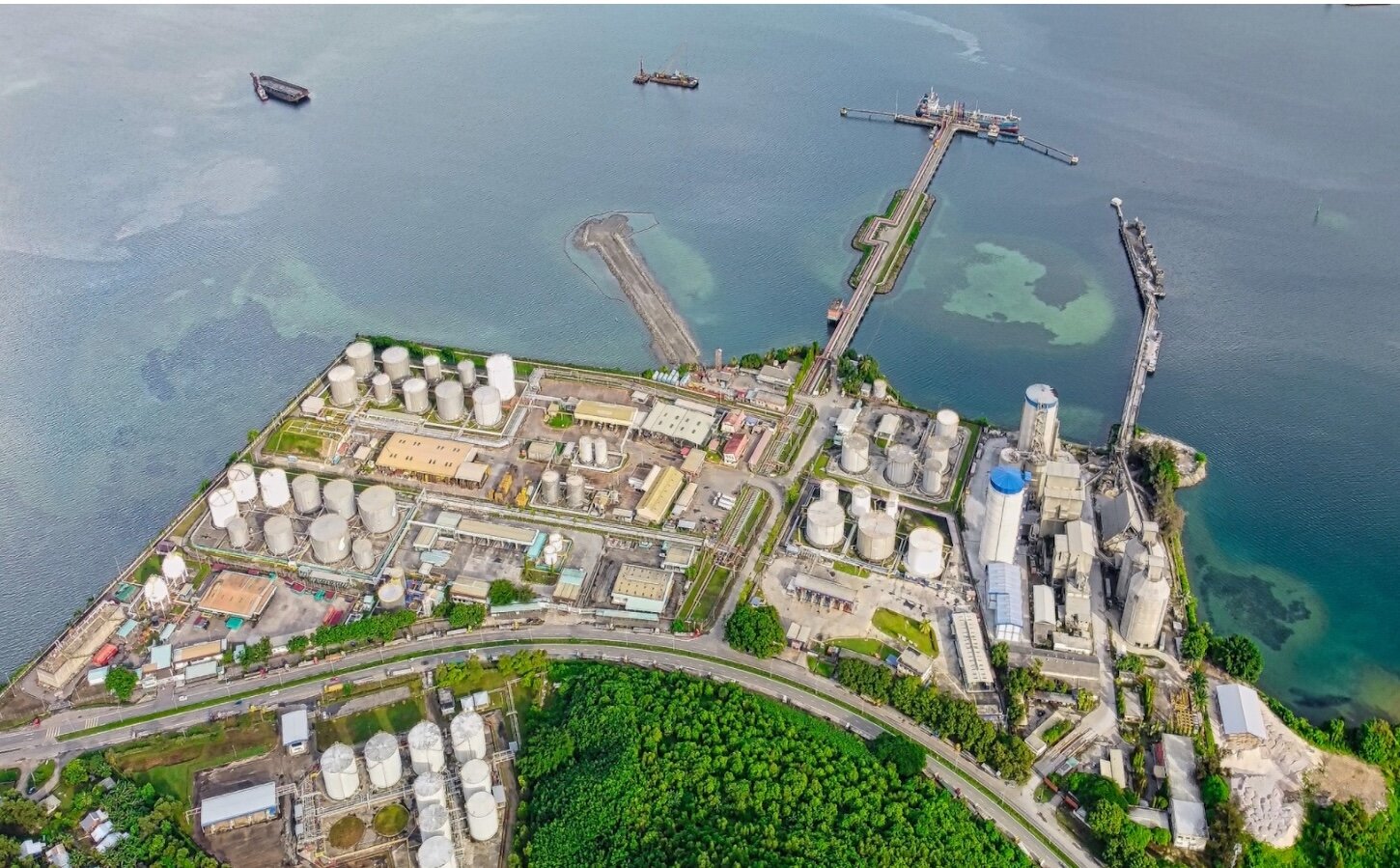
Under the Petroleum Development Act 1974, Sabah and Sarawak receive a 5 per cent cash payment, not oil royalty, based on the value of petroleum produced from their territories. The remaining 95 per cent of petroleum revenue is managed through Petronas, which distributes funds across its operations, including payments to the federal government and production-sharing contractors. Petronas remains one of the largest contributors to federal revenue, generally contributing a substantial share to the annual budget. Sabah and Sarawak receive much smaller annual cash payments estimated at RM2–3 billion annually, depending on oil prices and production levels.

Sapangar Bay oil terminal, Sapangar Bay, Kota Kinabalu, Sabah.
Source:
Sabah Ports Authority, 2026.


Offshore oil rig platform, near Miri, Sarawak .
Source:
Free Malaysia Today, 2021.


Beyond petroleum, Sabah and Sarawak argue that significant economic value generated from their natural resources and local markets flows to federally linked companies and corporations headquartered outside the states. Essential services such as electricity, telecommunications, broadcasting, aviation, and private healthcare are largely controlled by national companies, resulting in substantial revenue outflows. Sabah is Malaysia’s largest crude palm oil-producing state. Yet approximately 90 per cent of oil palm plantations are controlled by large federally linked companies. While these industries generate substantial wealth from Sabah’s resources, the level of reinvestment and local economic benefits remains minimal.

‘Project IC’ and rotation of Chief Ministers: Sabah’s political transformation

During Mahathir Mohamad's tenure as Prime Minister (1981–2003), he saw an opportunity to expand UMNO's influence in Sabah, citing the state’s perceived political instability. Two developments in particular had profound and lasting consequences: large-scale demographic engineering, often referred to as ‘Project Mahathir’ or ‘Project IC’, and the introduction of the Chief Minister rotation system (1994–2003).

‘Project IC’ allegedly involved granting of Malaysian citizenship and identity cards to illegal migrants, primarily from the southern Philippines and Indonesia (Chia, 2026). Although the programme is widely believed to have operated on a large scale during the late 1980s and 1990s, subsequent investigations have suggested that similar activities had begun as early as the 1970s and continued over an extended period. At its core, ‘Project IC’ involved government officials issuing Malaysian blue identity cards and citizenship documents to undocumented immigrants, allegedly in exchange for political support. Between 1970 and 2010, Sabah's population increased fivefold from approximately 650,000 to more than 3.2 million.

The scale and speed of Sabah’s population growth far exceeded demographic trends observed elsewhere in Malaysia and are likely to have resulted from the extraordinary growth in illegal migration and the implementation of ‘Project IC’. Public concern over the issue eventually led to the establishment of the Royal Commission of Inquiry (RCI) on Illegal Immigrants on 11 August 2012. Its findings confirmed that identity cards had been improperly issued to large numbers of illegal immigrants. The programme fundamentally altered Sabah's ethnic composition and electoral landscape, with long-term implications for the state’s politics, economy, and social fabric.

Another controversial measure introduced was the rotation of the Chief Minister’s office. Sabah remains the only Malaysian state to have implemented such a scheme, under which the Chief Minister was replaced every two years. Between 1994 and 2003, five individuals served as Chief Minister under this arrangement. Although the policy was defended as a means of maintaining political stability and ensuring power-sharing among the state’s major ethnic communities, critics argued that it undermined democratic governance and accountability, disrupted policy continuity, and prevented successive administrations from implementing long-term development strategies.

The combination of demographic engineering and political restructuring profoundly reshaped Sabah's political landscape. These political interventions enabled greater federal control over the state while weakening Sabah's political autonomy. Frequent changes in political leadership also contributed to administrative instability. Since the formation of Malaysia, Sabah has had 16 Chief Ministers, compared with only six in neighbouring Sarawak.

Restoring Sabah and Sarawak as equal partners

Speaking at the Malaysia Day celebrations at Padang Merdeka, Kota Kinabalu, on 16 September 2018, Mahathir Mohamad, during his second prime ministership, 2018–2020, said that under MA63, Malaya, North Borneo (Sabah), Sarawak, and Singapore came together as equal partners to form the Federation of Malaysia (The Straits Times, 2018). He said his government recognised the grievances of Sabah and Sarawak and was committed to restoring the status of Sabah and Sarawak as equal partners in accordance with the spirit and provisions of MA63. He acknowledged that successive governments had failed to fully honour the agreement, the constitutional rights of Sabah and Sarawak had been neglected, and their wealth siphoned off. His admission was significant as many of these grievances arose during his first tenure as Prime Minister.

The first attempt to restore Sabah and Sarawak's status as equal partners in the Federation, through a constitutional amendment tabled in April 2019, failed after the government was unable to secure the required parliamentary support. In a second attempt, under Prime Minister Ismail Sabri Yaakob, the constitutional amendment to restore Sabah and Sarawak as equal partners was approved in December 2021, after over two-thirds of Dewan Rakyat members supported the bill. Former Minister in the Prime Minister's Department Wan Junaidi Tuanku Jaafar said the amendment would see MA63 placed on par with the Federation of Malaya Agreement 1948 and the Federation of Malaya Independence Act 1957. Wan Junaidi further said that by recognising MA63 in the Federal Constitution, the government could now refer to all the promises and safeguards agreed in 1963 in detail as stated in the Inter-Governmental Committee Report.

More than six decades after Malaysia’s formation, MA63 remains an unresolved issue (Thomas, 2021). Disputes over autonomy, revenue sharing, constitutional safeguards, and control over natural resources continue to shape federal-state relations. Recent statements by the Federal Government that several MA63 claims remain unresolved, including oil royalties, petroleum resources, the Territorial Sea Act 2012, and rights over the continental shelf, have further fuelled public dissatisfaction in Sabah and Sarawak.

Conclusion

The formation of the Federation of Malaysia went through a rigorous process culminating in the signing of MA63. However, dissatisfaction among many Sabahans and Sarawakians with the implementation of the agreement remains, particularly with respect to their constitutional rights as equal partners with Peninsular Malaysia, including parliamentary representation and the allocation of revenue from the exploitation of their abundant mineral and other natural resources.

Since 2018 and the fall of UMNO, Sabah and Sarawak have experienced a growing political awakening, with local leaders becoming increasingly aware of their strategic role in determining the formation and stability of federal governments. The fragmentation of political power in Peninsular Malaysia has strengthened the bargaining position of the Borneo states, enabling them to push more assertively for the restoration of rights under MA63. This changing political landscape has transformed Sabah and Sarawak from being perceived as peripheral states into influential stakeholders whose support can determine the survival of the federal government.

The recent growing emphasis on identity politics, race, and religion in Peninsular Malaysia has contributed to a widening sense of political and cultural distance between the Borneo states and the mainland. Many Sabahans and Sarawakians increasingly view their communities as having a distinct identity and indigenous heritage. There is a growing desire to preserve their political identity and distance themselves from what they perceive as increasingly polarised and divisive political discourse in the Peninsula.

The federal government needs to pay greater attention to its eastern flank. Beyond the long-standing economic disparities between Peninsular Malaysia and the Borneo states, the physical separation created by the South China Sea has reinforced psychological, political, and cultural differences. Unless these challenges are addressed, the geographical divide risks evolving into a deeper sense of political and national disconnect and creating deeper cleavages.

Further reading

Allen, R. 1968. Malaysia: Prospect and Retrospect: The Impact and Aftermath of Colonial Rule. London: Oxford University Press.

Chia, M. P. F. 2026. Citizenship in Crisis: The Ripple Effect of the Undocumented Migrants in Sabah. Petaling Jaya: Strategic Information and Research Development Centre.

Colonial Office. 1962a. Report of the Commission of Enquiry, North Borneo and Sarawak, 1962. Cmnd 1794. London: Her Majesty’s Stationery Office.

________ 1962b. Malaysia: Report of the Inter-Governmental Committee, 1962. Kuala Lumpur: Government Printer.

Jomo, K. S. 2004. The New Economic Policy and Interethnic Relations in Malaysia. Identities, Conflict and Cohesion Programme Paper No. 7. Geneva: United Nations Research Institute for Social Development. https://cdn.unrisd.org/assets/library/papers/pdf-files/jomo-new-economic-policy.pdf.

Kitingan, J. G. and Ongkili, M. J. (eds). 1989. Sabah: 25 Years Later, 1963–1988. Kota Kinabalu: Institute for Development Studies (Sabah).

Lim, R. 2008. Federal-State Relations in Sabah, Malaysia: The Berjaya Administration, 1976–85. Singapore: Institute of Southeast Asian Studies.

Ranjit Singh, D. S. 2000. The Making of Sabah, 1865–1941: The Dynamics of Indigenous Society. Kuala Lumpur: University of Malaya Press.

Massey, A. 2006. The Political Economy of Stagnation: British North Borneo under the Chartered Company, 1881–1946. Kota Kinabalu: Sabah State Archives.

Department of Statistics Malaysia. 2025. Poverty in Malaysia 2024. Putrajaya: Department of Statistics Malaysia. https://www.dosm.gov.my/portal-main/release-content/poverty-in-malaysia-2024.

Ross-Larson, B. 1976. The Politics of Federalism: Syed Kechik in East Malaysia. Singapore: Ross-Larson.

Samad, J. A. 2023. Unequal Partners: Race, Religion, Domination and Inequality in East Malaysia. Petaling Jaya: Strategic Information and Research Development Centre.

________ 2026. Sabah’s Rocky Road to Malaysia: Events that Shaped Sabah’s Political and Economic Realities. Petaling Jaya: Strategic Information and Research Development Centre.

Shad Saleem Faruqi. 2026. ‘At a Crossroads: Malaysian Federalism and Special Fiscal Rights of Sabah and Sarawak’. RSIS Commentary, No. 092, 28 April. Singapore: S. Rajaratnam School of International Studies. https://rsis.edu.sg/wp-content/uploads/2026/04/CO26092.pdf.

Stockwell, A. J. (ed.). 2004. British Documents on the End of Empire, Series B, Volume 8: Malaysia. London: The Stationery Office.

The Straits Times. 2018. ‘Sabah, Sarawak to be Restored as Equal Partners Forming Malaysia, Not Just Component States, Says PM Mahathir’, 16 September. https://www.straitstimes.com/asia/se-asia/sabah-sarawak-to-be-restored-as-equal-partners-forming-malaysia-not-just-component.

Thomas, T. 2021. ‘Pan-Malaysian Relations and MA63’, in My Story: Justice in the Wilderness. Petaling Jaya: Strategic Information and Research Development Centre, pp. 348–357.

Tregonning, K. G. 1965. A History of Modern Sabah (North Borneo, 1881–1963). 2nd ed. Singapore: Published for the University of Singapore by the University of Malaya Press.



SHARE THIS PAGE
RELATED SITES

ECONOMIC HISTORY OF MALAYSIA
c/o Asia-Europe Institute
University of Malaya,
50603 Kuala Lumpur
Ooops!
Generic Popup2