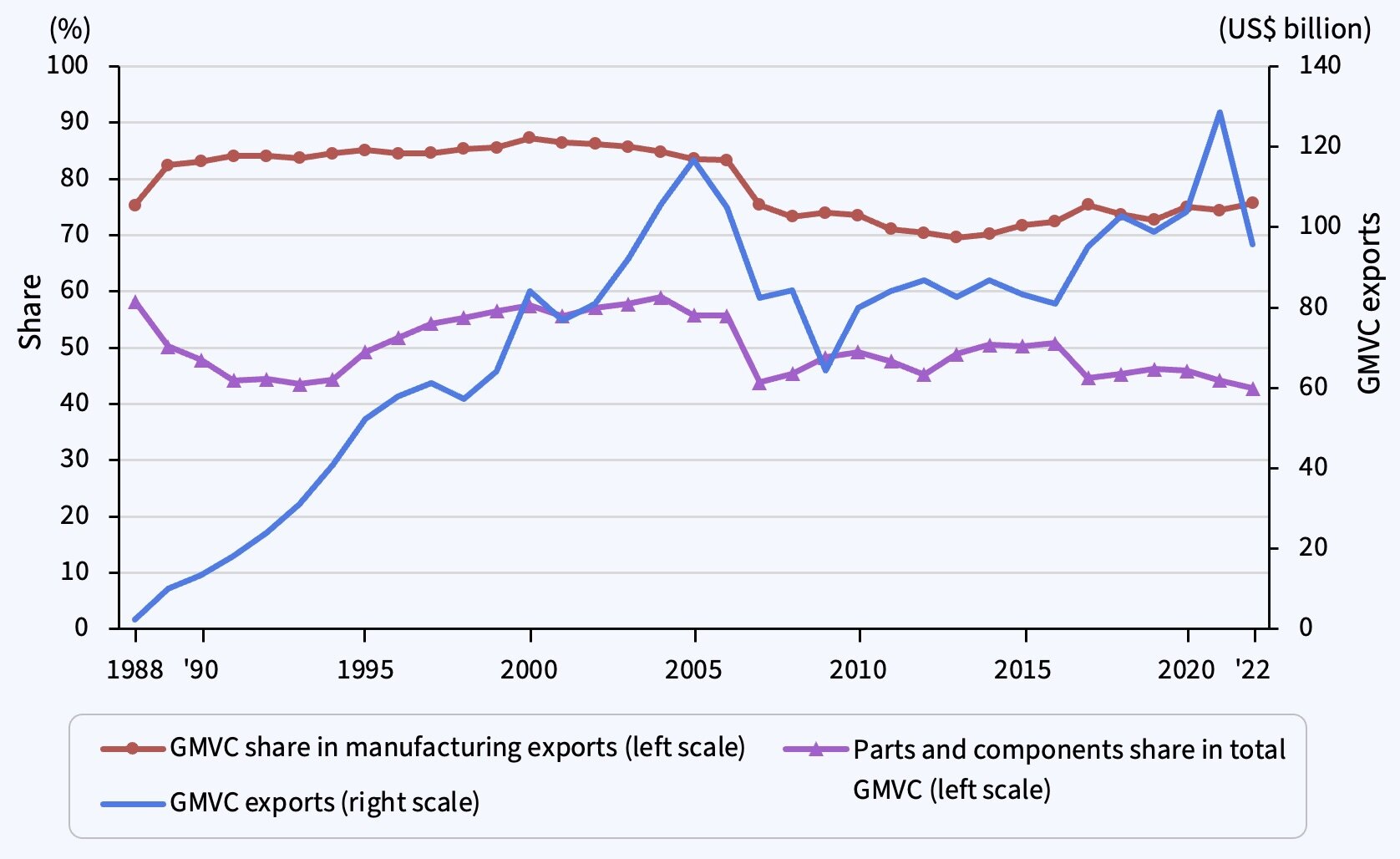
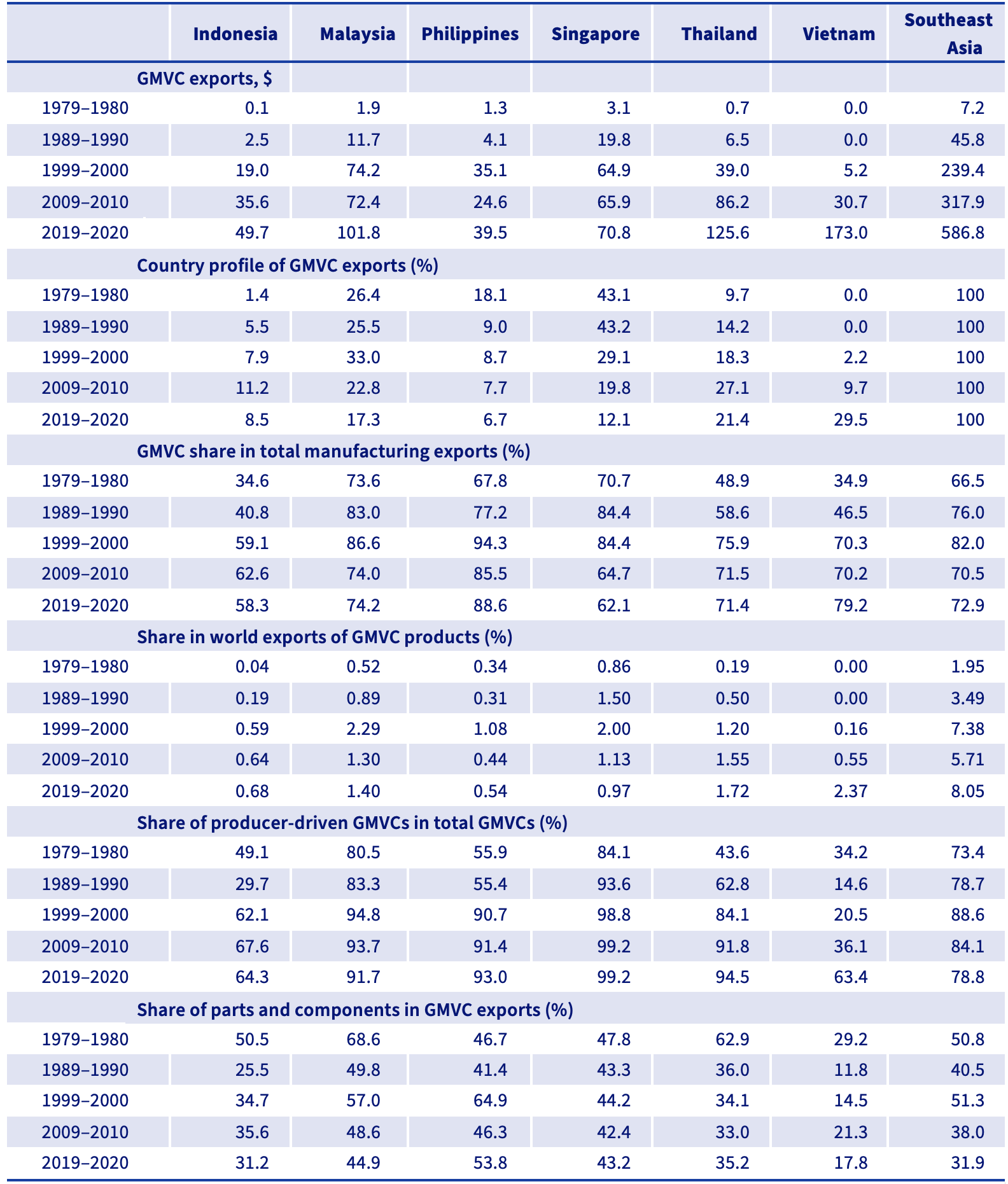
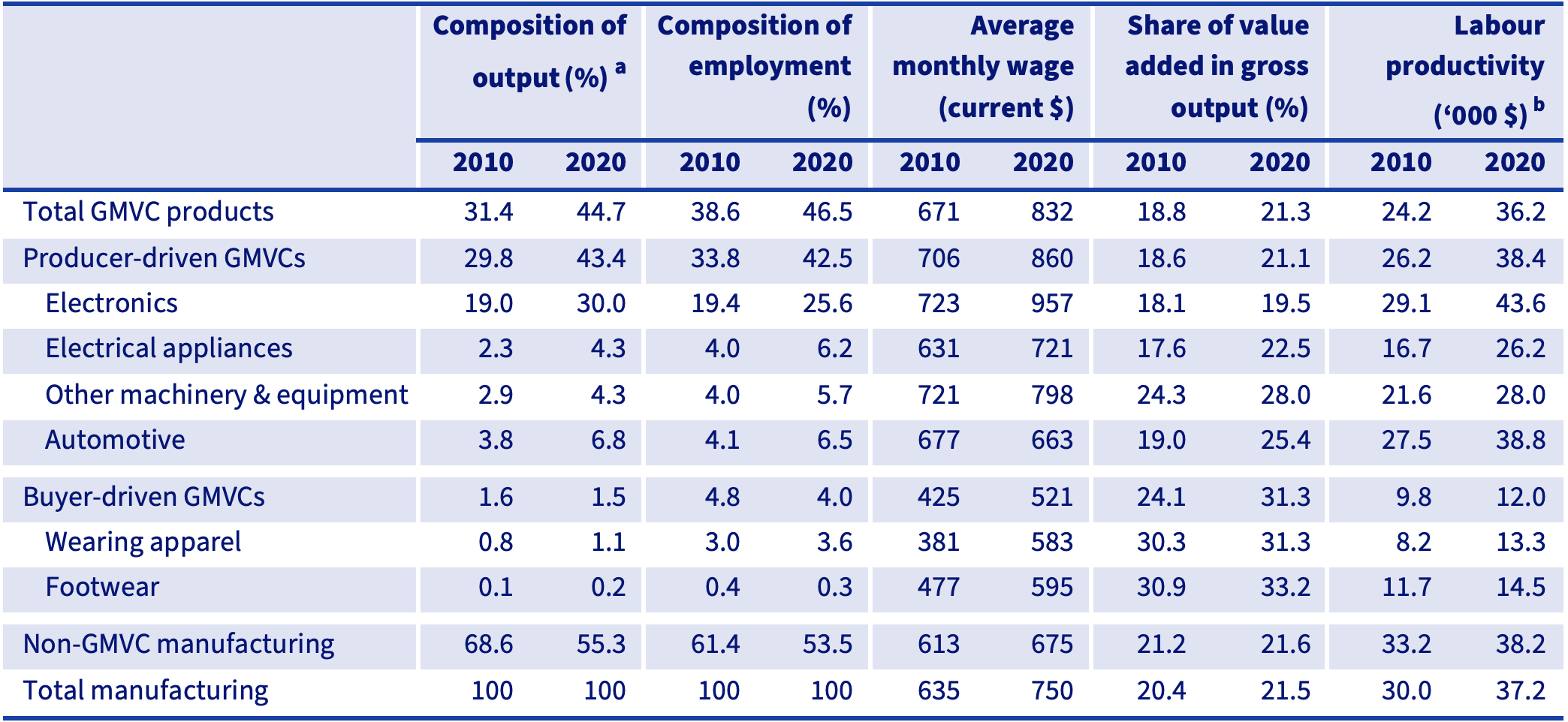
The most important international industrial organization innovation over the past half century is the vertical disintegration of production, with separate stages carried out in different countries, widely known as GPS. This has replaced the fully integrated, single-country, and typically single-firm, production process with decentralized multi-country operations in which the production process is ‘sliced up’ into separate, highly specialized and tightly integrated supplier networks. Particularly in the electronics, automotive, machinery, and precision-goods industries, it is now common for the final assembled product to consist of components produced in several countries.
The cross-border dispersion of production processes is generally organized by large multinational enterprises (MNEs) with subsidiaries or long-term subcontractors in the producing countries. The location of these various suppliers is primarily market-driven: simple, labour-intensive activities are found in lower-wage economies; R&D-intensive activities are located in countries with the necessary scientific base; while final assembly typically occurs in countries that can manage large-scale, diverse production activities for export to the rest of the world.
GPS is not a new phenomenon. There is ample anecdotal evidence of evolving trade in parts and components within branch networks of MNEs dating back to the early 20th century. What is unprecedented about the contemporary process of GPS is its wider and ever-increasing product coverage, and its rapid spread from mature industrial countries to developing countries. Over the past four decades or so, production networks have gradually evolved, encompassing many countries and spreading to many industries such as sporting goods, garments, footwear, automobiles, televisions and radio receivers, sewing machines, office equipment, electrical machinery, machine tools, cameras, watches, light-emitting diodes, solar panels, and surgical and medical devices. In general, industries with the potential to break up the production process without significantly increasing transport costs are more likely to move to peripheral countries. From about the late 1970s, there were two other important developments in the process, setting the stage for the rapid expansion in the share of fragmentation-based trade in world trade.
First, as an outcome of advances in modular production technology, some fragments of the production process in certain industries have become ‘standard fragments’ that can be effectively used in several products. Examples include long-lasting cellular batteries, originally developed by computer producers and now widely used in cellular telephones and electronic organizers; transmitters, which are now used not only in radios (as originally designed) but also in personal computers and missiles; and semiconductors, also called integrated circuits or chips, which have spread beyond the computer industry into consumer electronics, motor vehicle production, and many other product sectors.